

What AI@STRATEGY reveals about the next phase of AI in business
- Luisa Lühdorff
- 17 November 2026
- BCCG Commentary
Almost every company is experimenting with artificial intelligence by now: a chatbot here, a proof of concept there. Yet only a few have embedded AI into their strategy, processes and leadership deeply enough to turn it into a genuine competitive advantage. The real challenge is moving from pilot project to scale.
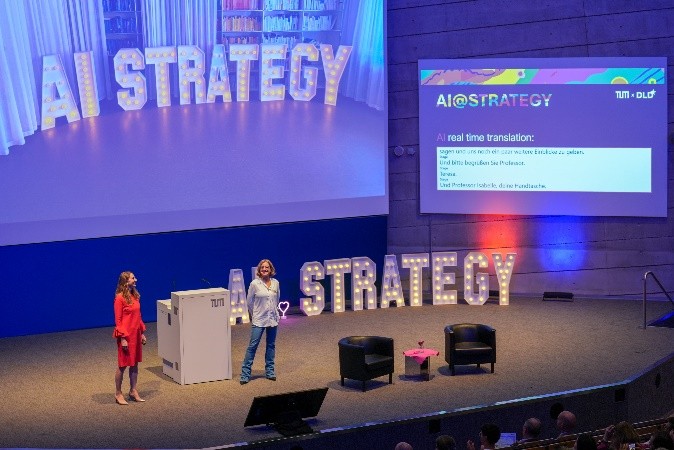
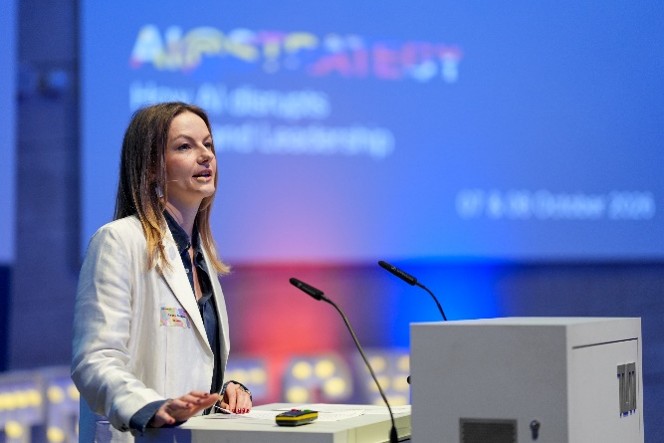
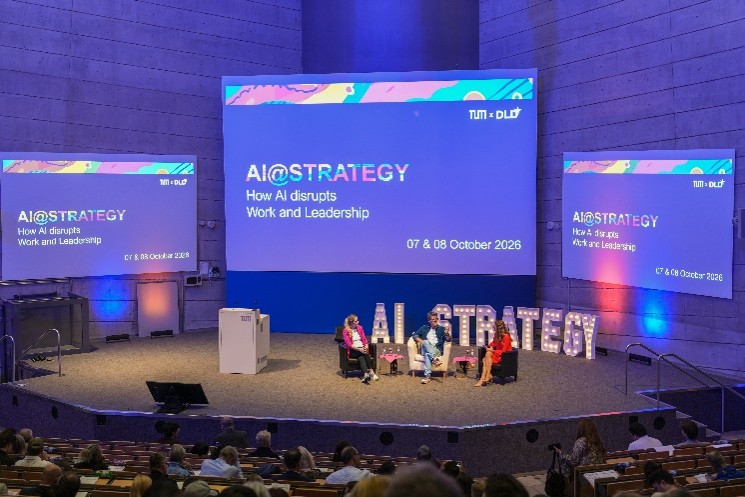
That challenge was the central theme of the AI@STRATEGY conference, held on 7 and 8 October 2026 in the Audimax of the Technical University of Munich. Together with DLD, the Chair of Strategy and Organization at the TUM School of Management brought together more than 2,000 guests and over 50 speakers from academia, business, politics, and the startup ecosystem, including BMW, Allianz, BayernLB, Deloitte, OpenAI, Google, and Anthropic, as well as researchers from Harvard, MIT, Berkeley, and Columbia University. British academia was particularly well represented, with professors from Cambridge Judge Business School, Imperial College London, the London School of Economics and Brunel University of London contributing across both days of the programme.
1. From assistance to delegation
AI is no longer just a tool that supports people. Drawing on usage data, David Holtz (Columbia Business School) showed how its use is shifting from assistance to the delegation of entire tasks. For companies, this is a strategic question: which tasks do we hand over, with what level of control, and who is accountable? As Isabell Welpe put it in her keynote with Theresa Treffers: “For AI use to grow, AI has to become more reliable, and people have to learn to delegate more to it.” BMW outlined its path towards an “AI-native” operating model, while Allianz described scaling AI applications across the group. In both cases, the challenge is less about technology than about organisation – and the question of accountability leads directly to governance.
2. Governance is strategy
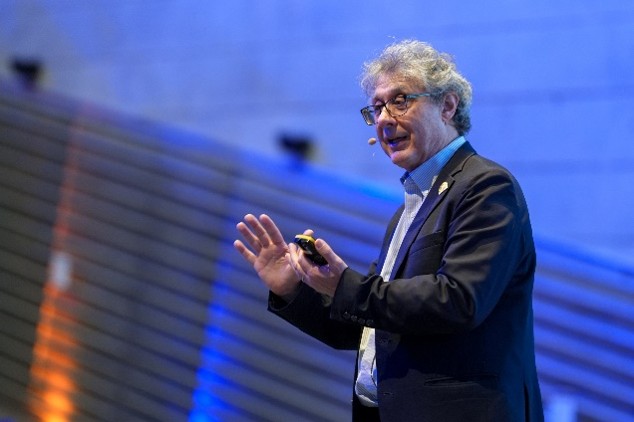
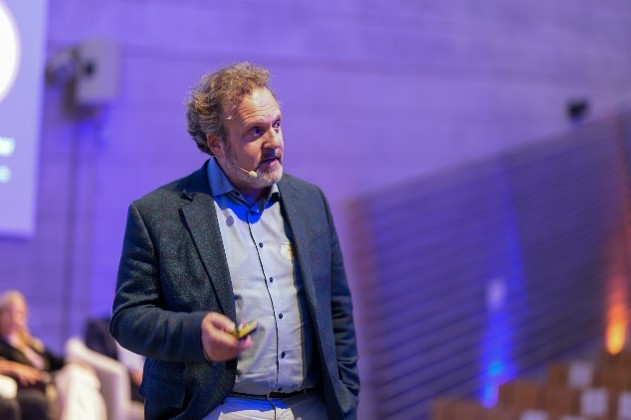
Governance was a recurring theme throughout the conference, with an entire session dedicated to risk, ethics and governance. The message was strikingly consistent. Good AI governance is not a compliance add-on but the precondition for deploying AI at scale. Christopher Tucci (Imperial College) spoke about how to scale governance, Robert Mahari (Anthropic, Stanford CodeX) about the interplay between risk, regulation and institutional trust, and Francesca Toni (Imperial College) about explainable AI as a foundation for strategic trust. Shaz Ansari (Cambridge) showed how AI start-ups navigate the tension between dependence on large platforms and questions of liability. Meanwhile, Parliamentary State Secretary Thomas Jarzombek made the case for lean AI rules as Germany’s path back to competitiveness.
3. Leadership is changing
The second day focused on leadership. Jacqueline Ng Lane (Harvard) discussed how organisations can design joint decision-making between humans and AI, while Emilio Castilla (MIT) examined how AI can reinforce bias and inequality in organisations. A panel with Dorottya Sallai (LSE) and Catherine Wang (Brunel) explored which skills leaders will need in the future. Hannah Riley Bowles (Harvard Kennedy School), for instance, examined whether AI-based negotiation coaching reinforces traditional gender roles. Overarching all of this was the question of Europe’s role. Theresa Treffers was clear: “If we want AI sovereignty in the EU, we need to allow and promote more transfer from research. At the moment, Europe plays no role in developing foundational AI models.”
Looking ahead
The conference made clear that the bottleneck to scaling AI is no longer technology, but organisation, governance and leadership. Three topics stood out for the next phase. The first is physical AI. As Matthias Nießner (TUM) and Alexander Gerfer (Würth Elektronik eiSos) showed, AI is moving beyond the screen into robotics and physically grounded world models, an area where Europe’s industrial base is a genuine advantage. The second is the development of reliable and responsible AI, which is the precondition for trust and therefore for adoption at scale. The third is culture. As more tasks are delegated to AI, organisations need to preserve the values, collaboration and judgement that make them distinctive.
Europe is well placed to shape these questions, with excellent research, strong industrial companies and a powerful Mittelstand. For Germany and the EU, the task now is to turn research into value creation, and this depends on strong international ties, including with our partners in the UK. We will carry the conversation forward at our roundtables in Davos and look forward to continuing the exchange that began in Munich with partners in Europe and beyond.
Further information: www.aistrategyconference.com
Luisa Lühdorff
Technical University of Munich (TUM)